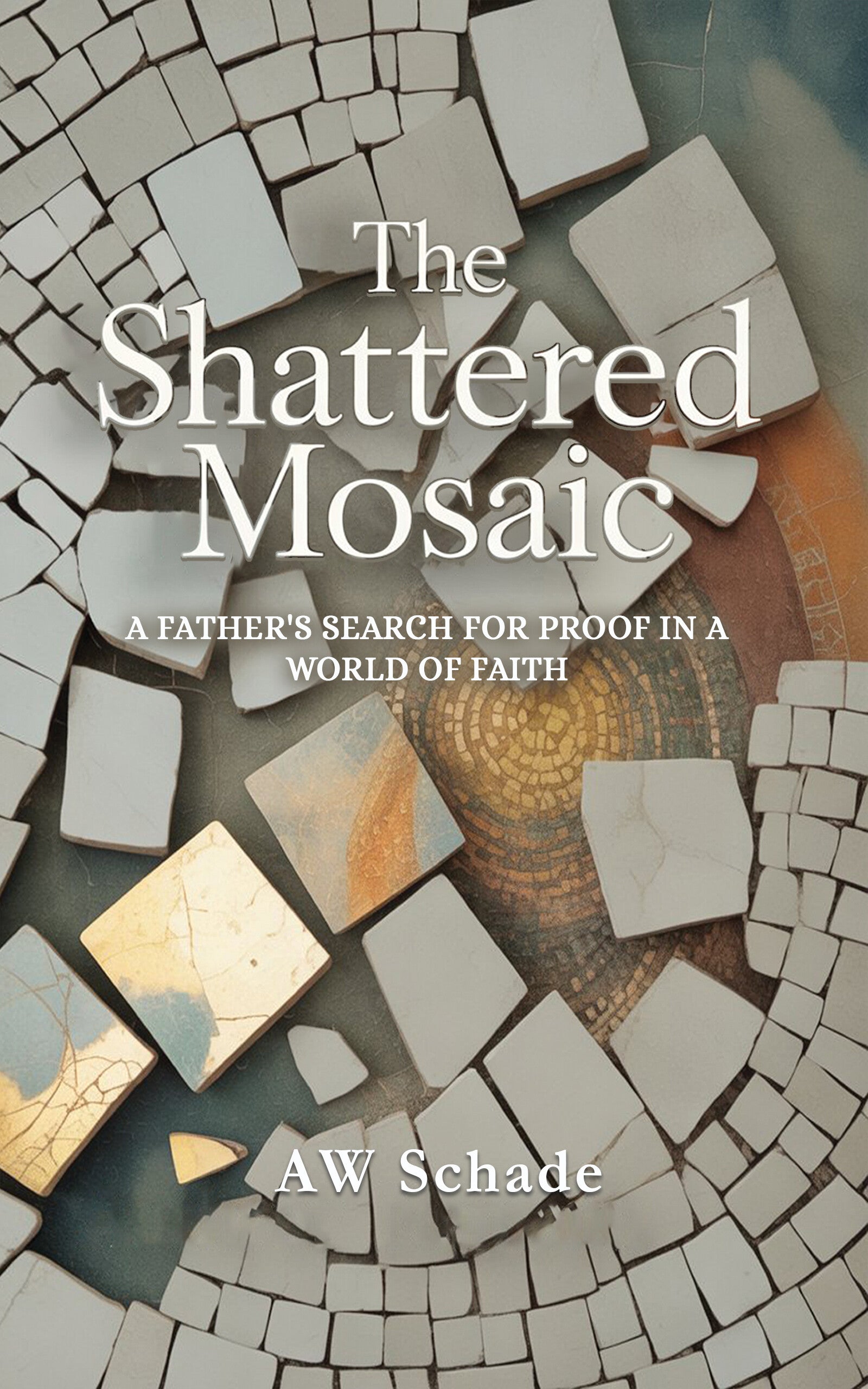
He promised his nine-year-old daughter he would protect her forever.
Three weeks later, she was dead—and the entire architecture of Jacob Hinsen’s life began to collapse.
A successful trial lawyer and Vietnam combat veteran, Jacob has spent his life examining evidence, exposing contradictions, and demanding the truth. But grief will not submit to cross-examination.
When friends and clergy assure him that his daughter Jessica is “with God,” Jacob hears comfort but not proof. Unable to accept that death has separated them forever, he leaves behind a fracturing marriage, a faltering law practice, and the people still trying to love him. His search carries him to Rome, Istanbul, and Jerusalem, where he questions Christianity, Islam, and Judaism about the promise each makes to the grieving: that those we love are not truly lost.
Yet every answer opens another question.
The Shattered Mosaic is not simply a journey through religion. It is the deeply human story of what grief does to the living, how it isolates, damages relationships, consumes purpose, and can make even love feel unreachable.
Readers walk beside Jacob through sorrow, doubt, anger, unexpected compassion, and the painful recognition that while he has been searching for the dead, the living have been struggling to survive without him.
Jacob may never find the certainty he demands. What he carries home may be something quieter and perhaps more precious: the possibility that when proof is impossible, love, mercy, responsibility, and human connection can still give life meaning.
For anyone who has experienced loss, stood beside someone suffering, or wondered how to continue when the beliefs that once held life together no longer do.
A five-star Reedsy Discovery “Must Read.”
“The bravest premise in contemporary literary fiction I have encountered in years.”
—Fiza Pathan, award-winning author and educator

The Shattered Mosaic: A Guide for Seekers, Skeptics, and Scholars
Introduction: The Shattered Mosaic is the result of 70 years of questioning and 15 years of writing. These questions are designed to help readers navigate the same "witness stand" that Jacob Hinsen built for the world’s religions.
I. The Lawyer’s Scrutiny
-
Jacob approaches theology with the mind of a trial lawyer. Is "faith" a valid defense when it contradicts "evidence"? Can a legal mind ever truly find peace in a world governed by "mystery"?
-
In the courtroom, a "hostile witness" is someone whose interests are contrary to the case. Why does Jacob treat the "Big Three" religions as hostile witnesses? Is he being fair, or is his grief clouding his judgment?
II. The Nature of God and Science
-
The Reedsy review calls this book "scientifically rich." How does the "man on the train’s" explanation of death and God change your perspective on the physical vs. the metaphysical?
-
Arnold Kellner, the philosophy professor, suggests that the "search" might be more important than the "answer." If Jacob found undeniable proof of God, would his journey be more or less meaningful?
III. The Theology of Grief
-
Father Doyle remains a true friend to Jacob despite their fundamental disagreements. What does their friendship suggest about the "Proof of Love" vs. the "Proof of God"?
-
Yasmin al-Khafaji speaks about "love creating meaning between strangers." In a world without a "Master Architect," is human connection enough to sustain us?
IV. The Geography of Faith
-
Jacob travels from Chicago to the Vatican to Jerusalem. How does the physical setting of these "holy sites" impact the way he perceives the "Shattered Mosaic" of religion?
-
Does the novel suggest that all religions are searching for the same thing, or are their differences too vast to ever truly fit together into a single "mosaic"?
V. The Conclusion of the Search
-
The book avoids a "tidy" ending. Why is an honest "I don't know" sometimes more courageous than a certain "I believe"?
-
After 70 years of questioning, the author presents a world of fragments. If your life were a mosaic, which "shards" of faith, logic, or love would you choose to keep?

A fresh, evocative discourse about the afterlife, God, religion, science, life and death
Synopsis
"Unflinching, thought-provoking, and deeply moving. This book asks the questions most are afraid to answer honestly."
A courtroom drama for the soul
"For Jacob Hinsen, a lawyer of logic and reason, his world shatters with the senseless death of his nine-year-old daughter. He embarks on a powerful and emotional odyssey, leaving his career behind to cross-examine faith itself.
From the rigid doctrines of fundamentalism to the serenity of mystical paths, Jacob's journey is a profound exploration of grief, doubt, and the human search for a meaning that transcends tragedy.
A grieving dad embarks on a journey in AW Schade’s novel, The Shattered Mosaic: A father’s search for proof in a world of faith. Behind, he leaves the people he loves, the job, and everything else. Of course, life doesn’t wait for any man, as he immediately realizes.
Even so, this man has questions for which he needs fact-based answers. He trots the globe, interviewing and writing in his journals, all the time disappointed because the answers he gets can’t pass his scrutiny. Is he framing his questions wrong? Or some questions don’t have answers, mysteries and are subject to one’s interpretation?
The question of what fate awaits man after death and whether God truly exists are approached from every angle in this book, be it religiously or scientifically.
Religiously, Jacob goes to churches and mosques, where he’s assured his dead loved one awaits him in Heaven and that God watches over His creation, knows His people’s pain, such as Jacob’s. Scientifically, Jacob encounters a man on the train, who sits him down and explains death and God in straight, clear terms.
First, as a reader, I’m compelled to appreciate Schade’s work. This book is philosophically, religiously and scientifically rich. Earlier, I had wondered why take readers through 420 pages on a topic that could be answered in a mere page. However, as I read along, I began to see the light: to realize the book I’m holding in my hands is a convergence of ideas, an encyclopedia.
Grief affects us all, at some darkest moments in our lives, and while we’d get back to living at some point, Jacob doesn’t. I followed Jacob’s journey, knowing he’d give up at some point, especially after he received bad news from home and no tangible answers came his way, but Jacob defied the odds.
His years as a lawyer make him the ideal person to engage men of the cloth and of science in constructive debate. And there are times when he annoys, because he wants faith to be explained to him as a lawyer would explain a crime in the courtroom, though his hosts are gentle and understanding people. As our protagonist here, I give Jacob a thumbs up.
Still on characters, Father Doyle impressed me. He’s patient, and above all, his friendship with Jacob remains true. I also like Arnold Kellner, a philosophy professor who briefly comes into Jacob’s life but leaves a great impression.
The words of Yasmin al-Khafaji still echo in my head: "You came seeking answers about God and your daughter. I gave you theology. But this hour, this laughter, this connection, perhaps this is the only proof we have that something transcends death. Love creating meaning between strangers."
Sarah’s story is illuminating as it explains why it’s important to hold onto hope even in the face of adversities.
To readers out there, read this book. It doesn’t matter your religion.
Reviewed by
Emily Omondi
What readers are saying
"The Shattered Mosaic isn’t just a novel, it’s a soul-deep exploration of grief, faith, and the universal human search for meaning after unimaginable loss. What makes this book extraordinary is the raw honesty with which you follow Jacob’s desperate quest to find his daughter not in this world, but in whatever lies beyond."
E. Green
"You have crafted more than a novel. You have built a vessel of raw, existential inquiry, a father’s heart-wrenching pilgrimage across three continents and three faiths, armed only with a lawyer's demand for evidence and a parent's unbreakable promise. The central, haunting question, "Does any path lead to Jessica?", resonates with a universal ache that transcends borders, which is the very space our book club exists to bridge."
Anthony
Co-Organizer, Events & Features
The Intercontinental Book Club
"Why I loved this story:
Intellectually Rigorous: Treats theology, philosophy, and science with equal seriousness; no straw-man arguments or easy dismissals
Religiously Respectful: Represents Catholic, Protestant, Orthodox, Sunni, Shia, Reform, and Orthodox traditions with accuracy and empathy
Emotionally Devastating: The opening hospital scene and encounters with nine-year-old Amina will break readers' hearts
Philosophically Honest: Doesn't advocate atheism or theism—presents a third way of living meaningfully within uncertainty
Universally Relevant: Speaks to believers questioning faith, skeptics seeking meaning, and anyone navigating loss without easy answers
Based on Deep Research: Author spent three years investigating comparative religion, theology, and philosophy of death."
Eugene Harris